
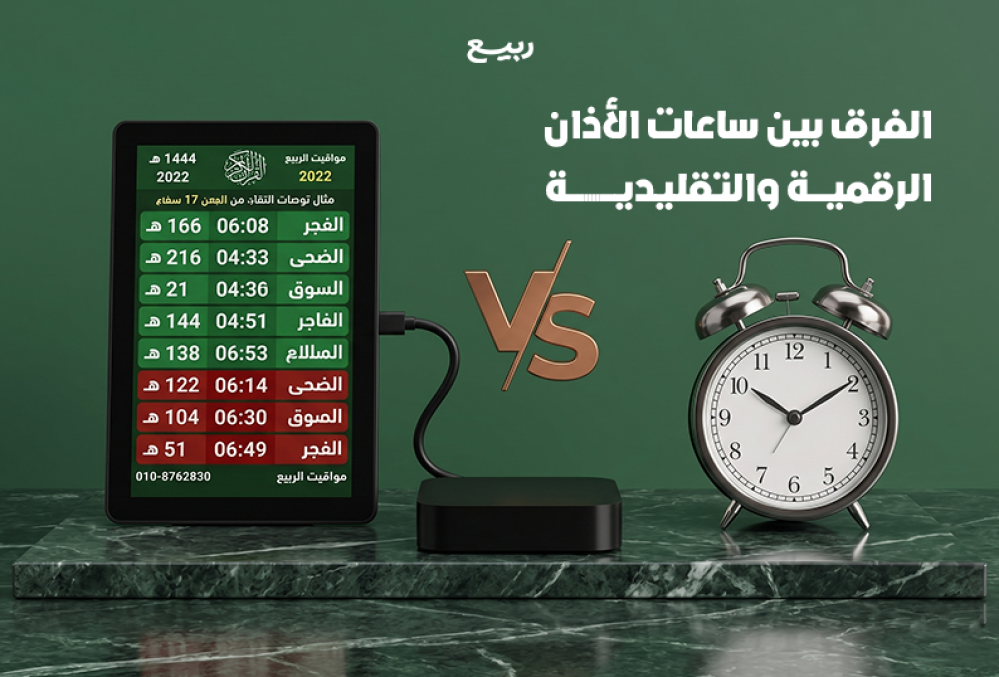
With the rapid development of smart devices that have become an integral part of our daily lives, the need has arisen for more accurate and flexible methods of displaying and organizing prayer times in homes, mosques, and various institutions. Rabee Store offers a diverse range of solutions related to prayer time display systems, helping users choose the most suitable option for their needs, whether at home, in a mosque, or any other facility, all presented in a practical and easily accessible manner through the website's various sections.
With the proliferation of modern devices, the term "digital prayer time clock" now refers to the advanced generation of prayer time display systems, while traditional clocks remain the simpler and older model. Therefore, it is important to understand the differences between the two before making a purchase decision, especially given the variations in capabilities, accuracy, and ease of use.
It is not just about displaying the time, but about a complete experience for managing prayer times on a daily basis, whether in terms of alerts, updates, or compatibility with the user's geographical location.
Comparing the advantages and disadvantages of digital and traditional prayer clocks
Understanding the differences between digital prayer clocks and traditional clocks is a crucial step in choosing the right device, as each type offers a completely different experience in terms of performance, functionality, and ease of use.
First: Traditional watches
Traditional clocks are the oldest form of displaying prayer times, relying primarily on manual data entry or on fixed, pre-set schedules.
How it works
These clocks work by manually setting prayer times, then displaying them daily without automatic updates. In some cases, they are adjusted when the city changes or when the seasons change.
Features
- Easy to use and requires no technical expertise.
- It does not require an internet connection.
- Low cost compared to modern systems.
- Suitable for simple use in small homes.
Disadvantages
- Manual adjustment is required when changing the location.
- It does not provide high accuracy in prayer times in some cases.
- It lacks automatic updates.
- Many additional features such as accommodation or advanced alerts are not supported.
- Limited functionality compared to modern digital systems.
Over time, reliance on this type gradually decreased due to the need for more accurate and flexible solutions in displaying prayer times.
Second: Digital prayer times
Digital prayer time clocks represent the modern development in prayer time display systems, as they rely on advanced electronic technologies that automatically calculate times based on the user's geographical location.
These systems are distinguished by their ability to provide a more accurate and comfortable experience, especially in places that require consistent daily organization, such as mosques, schools, and businesses.
How it works
These clocks work by entering the city or setting the location, then automatically calculate and continuously update prayer times without the need for frequent manual intervention.
Some modern systems can also be connected to large display screens via HDMI, making them suitable for mosques, halls, and institutions.
Features
- High accuracy in displaying prayer times according to location.
- Automatic update without manual intervention.
- Supported by a large number of cities around the world.
- The ability to play the call to prayer with a clear sound.
- Displays both Hijri and Gregorian dates.
- The ability to easily customize settings.
- Suitable for homes, mosques, and institutions.
Disadvantages
- Initial setup is required upon operation.
- Higher cost than traditional watches.
- It may require a continuous power supply.
- You need some basic knowledge for initial setup.
Despite these points, the demand for this type is constantly increasing due to its high accuracy and flexibility.
The difference in terms of accuracy of prayer times
One of the most important differences between the two types is that traditional clocks rely on manual adjustment which may lead to a slight difference in prayer times, while digital clocks rely on precise calculation systems linked to the geographical location, which makes the results more accurate and stable.
The difference in terms of daily use
Traditional clocks are suitable for simple use that does not require constant updates, while digital clocks provide a more sophisticated experience suitable for everyday use in structured environments such as mosques and educational institutions.
The difference in terms of flexibility and modernization
Digital clocks are distinguished by their ability to continuously update prayer times without user intervention, while traditional clocks require manual adjustment when changing city or seasons.
Modern systems for displaying prayer times
Some modern digital prayer time clock systems now rely on the idea of displaying prayer times on large screens, where the device is connected to the television or display screens using HDMI, which allows prayer times to be displayed clearly inside mosques, institutions, or even companies.
This type of solution provides a more organized and clear experience, especially in places that require a large, direct visual display of prayer times.
Which is more suitable to use?
The choice between traditional and digital watches depends on the nature of the use:
- If the use is simple in a small home, traditional clocks may suffice.
- However, if the goal is accuracy, organization, and automatic updating, then digital prayer clocks are the best option.
Institutions and mosques also tend to use digital systems more because of their high flexibility and ability to manage prayer times accurately and systematically.
Conclusion
In conclusion, it is clear that advancements in prayer time display systems have made a significant difference between simple traditional clocks and modern digital systems. With the wide variety of options available, digital prayer time clocks have become the most widely used choice in homes and mosques due to their high accuracy, ease of use, and simplicity of updating.
To learn how to choose the right clock comprehensively according to the use, whether for the home or the mosque, you can refer to the article "Best Prayer Time Clock for Homes and Mosques" where you will find a detailed explanation that will help you make the right decision before buying.
For a better experience in choosing the most suitable option, you can explore the solutions available within the Rabee Store , which helps you choose the most suitable option with ease and clarity.